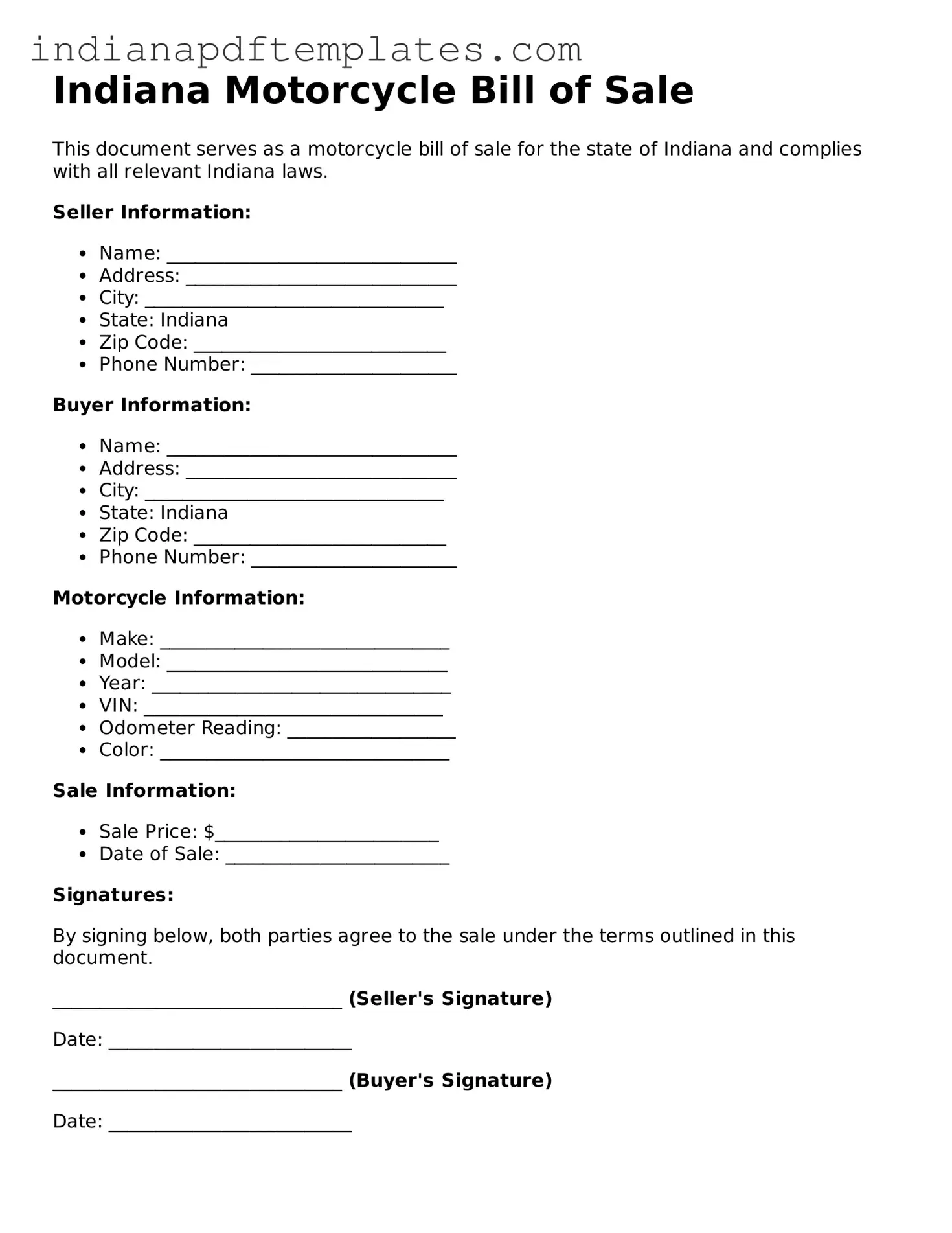
Blank Motorcycle Bill of Sale Form for the State of Indiana
Indiana Motorcycle Bill of Sale Sample
Indiana Motorcycle Bill of Sale
This document serves as a motorcycle bill of sale for the state of Indiana and complies with all relevant Indiana laws.
Seller Information:
- Name: _______________________________
- Address: _____________________________
- City: ________________________________
- State: Indiana
- Zip Code: ___________________________
- Phone Number: ______________________
Buyer Information:
- Name: _______________________________
- Address: _____________________________
- City: ________________________________
- State: Indiana
- Zip Code: ___________________________
- Phone Number: ______________________
Motorcycle Information:
- Make: _______________________________
- Model: ______________________________
- Year: ________________________________
- VIN: ________________________________
- Odometer Reading: __________________
- Color: _______________________________
Sale Information:
- Sale Price: $________________________
- Date of Sale: ________________________
Signatures:
By signing below, both parties agree to the sale under the terms outlined in this document.
_______________________________ (Seller's Signature)
Date: __________________________
_______________________________ (Buyer's Signature)
Date: __________________________
This bill of sale is intended to be used for record-keeping purposes, transfer of ownership, and registration in accordance with Indiana law.
PDF Properties
| Fact Name | Description |
|---|---|
| Purpose | The Indiana Motorcycle Bill of Sale form serves as a legal document to record the sale and transfer of ownership of a motorcycle. |
| Governing Law | This form is governed by Indiana Code Title 9, Article 17, which covers motor vehicle regulations. |
| Required Information | The form must include details such as the buyer's and seller's names, addresses, and the motorcycle's Vehicle Identification Number (VIN). |
| Signatures | Both the buyer and seller must sign the document to validate the transaction. |
| Notarization | While notarization is not mandatory, it can add an extra layer of authenticity to the document. |
| Record Keeping | It is advisable for both parties to keep a copy of the completed Bill of Sale for their records. |
| Tax Implications | The sale may be subject to sales tax, which the buyer is responsible for paying during the registration process. |
| Transfer of Title | The Bill of Sale is often required when applying for a new title in the buyer's name. |
| Condition of Sale | The form can include information about the motorcycle's condition, including any warranties or "as-is" statements. |
| State-Specific | Each state has its own requirements for a Bill of Sale, making it essential to use the Indiana-specific form for transactions in this state. |
Essential Points on This Form
What is a Motorcycle Bill of Sale in Indiana?
A Motorcycle Bill of Sale is a legal document that serves as proof of the sale and transfer of ownership of a motorcycle. This form includes essential details about the transaction, such as the names and addresses of the buyer and seller, the motorcycle's make, model, year, Vehicle Identification Number (VIN), and the sale price. Having this document is important for both parties, as it protects their rights and provides a record of the transaction.
Is a Motorcycle Bill of Sale required in Indiana?
While a Motorcycle Bill of Sale is not legally required in Indiana for the transfer of ownership, it is highly recommended. This document can help prevent disputes in the future and provides a clear record of the sale. Additionally, when registering the motorcycle with the Indiana Bureau of Motor Vehicles (BMV), the buyer may need proof of purchase, which a Bill of Sale can provide.
What information should be included in the Motorcycle Bill of Sale?
To ensure that the Motorcycle Bill of Sale is complete and effective, it should include the following information:
- The full names and addresses of both the buyer and seller.
- The motorcycle's make, model, year, and VIN.
- The sale price of the motorcycle.
- The date of the sale.
- Any warranties or conditions of the sale, if applicable.
Including all of this information helps to create a clear and comprehensive record of the transaction.
Do I need to notarize the Motorcycle Bill of Sale?
In Indiana, notarization of the Motorcycle Bill of Sale is not a legal requirement. However, having the document notarized can add an extra layer of protection for both the buyer and seller. A notary public verifies the identities of the parties involved and ensures that the document is signed willingly. This can be beneficial if any disputes arise in the future.
What should I do after completing the Motorcycle Bill of Sale?
After completing the Motorcycle Bill of Sale, both the buyer and seller should keep a copy for their records. The seller should also provide the buyer with the signed title of the motorcycle. The buyer will need this title to register the motorcycle with the Indiana BMV. It is advisable for the buyer to complete the registration process promptly to avoid any potential legal issues or penalties.
Misconceptions
When it comes to the Indiana Motorcycle Bill of Sale form, misconceptions can lead to confusion for both buyers and sellers. Here are five common misunderstandings, along with clarifications to help you navigate the process more effectively.
-
Misconception 1: A Bill of Sale is only necessary for new motorcycles.
This is not true. A Bill of Sale is important for both new and used motorcycles. It serves as proof of the transaction and can help protect both parties in case of disputes.
-
Misconception 2: The Bill of Sale must be notarized to be valid.
In Indiana, notarization is not a requirement for the Bill of Sale to be legally binding. However, having it notarized can add an extra layer of authenticity, which some buyers and sellers may prefer.
-
Misconception 3: A Bill of Sale replaces the title.
This is incorrect. The Bill of Sale does not replace the motorcycle title. It is a separate document that provides details about the transaction. The title must still be transferred to the new owner to establish legal ownership.
-
Misconception 4: Only the seller needs to sign the Bill of Sale.
Both the buyer and the seller should sign the Bill of Sale. This ensures that both parties acknowledge the terms of the sale and agree to the transaction.
-
Misconception 5: A Bill of Sale is not necessary if the transaction is done through a dealership.
Even when purchasing from a dealership, a Bill of Sale can still be beneficial. It serves as a record of the transaction and may be required for registration or insurance purposes.
Understanding these misconceptions can help you navigate the motorcycle buying and selling process in Indiana with confidence. Always ensure that you have the necessary documentation to protect your interests and make informed decisions.
Other Popular Indiana Templates
Proof of Residency Indiana - Submitting an accurate Affidavit of Residency can help individuals realize their rights.
Legal Separation Indiana - A Marital Separation Agreement can simplify the divorce process later on.
When engaging in potentially risky activities, understanding a comprehensive Release of Liability form can be vital. This document helps manage expectations and ensures that participants are aware of the inherent risks. For those looking to familiarize themselves with the essential aspects of this important legal tool, visit our guide on the proper use of Release of Liability.
Quitclaim Deed Indiana - No title insurance is typically provided with a Quitclaim Deed.