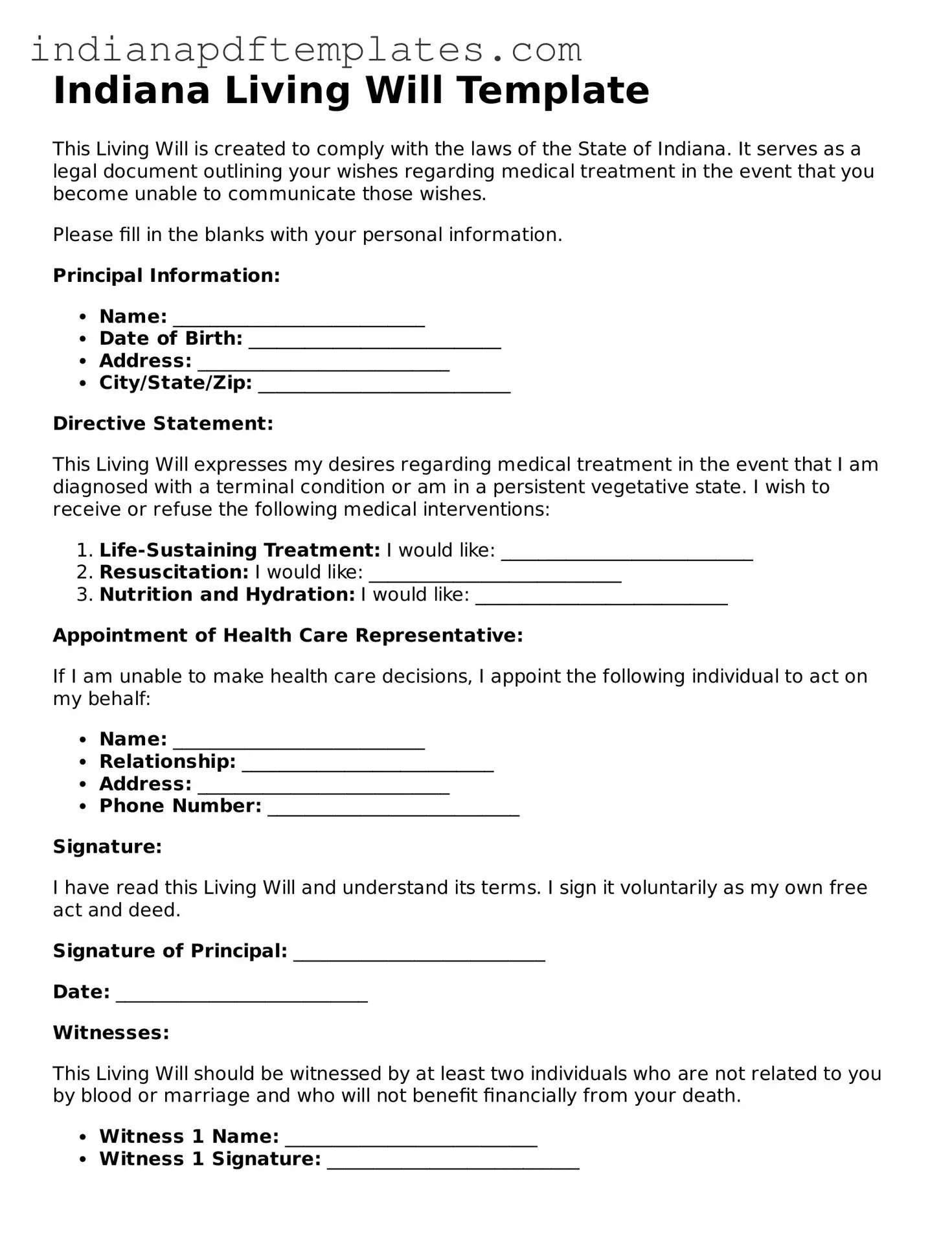
Blank Living Will Form for the State of Indiana
Indiana Living Will Sample
Indiana Living Will Template
This Living Will is created to comply with the laws of the State of Indiana. It serves as a legal document outlining your wishes regarding medical treatment in the event that you become unable to communicate those wishes.
Please fill in the blanks with your personal information.
Principal Information:
- Name: ___________________________
- Date of Birth: ___________________________
- Address: ___________________________
- City/State/Zip: ___________________________
Directive Statement:
This Living Will expresses my desires regarding medical treatment in the event that I am diagnosed with a terminal condition or am in a persistent vegetative state. I wish to receive or refuse the following medical interventions:
- Life-Sustaining Treatment: I would like: ___________________________
- Resuscitation: I would like: ___________________________
- Nutrition and Hydration: I would like: ___________________________
Appointment of Health Care Representative:
If I am unable to make health care decisions, I appoint the following individual to act on my behalf:
- Name: ___________________________
- Relationship: ___________________________
- Address: ___________________________
- Phone Number: ___________________________
Signature:
I have read this Living Will and understand its terms. I sign it voluntarily as my own free act and deed.
Signature of Principal: ___________________________
Date: ___________________________
Witnesses:
This Living Will should be witnessed by at least two individuals who are not related to you by blood or marriage and who will not benefit financially from your death.
- Witness 1 Name: ___________________________
- Witness 1 Signature: ___________________________
- Date: ___________________________
- Witness 2 Name: ___________________________
- Witness 2 Signature: ___________________________
- Date: ___________________________
Please retain this document in a safe place and provide copies to your medical provider and your health care representative.
PDF Properties
| Fact Name | Description |
|---|---|
| Purpose | The Indiana Living Will form allows individuals to express their wishes regarding medical treatment in the event they become incapacitated. |
| Governing Law | This form is governed by Indiana Code § 16-36-4, which outlines the legal framework for advance directives in the state. |
| Eligibility | Any adult who is at least 18 years old and of sound mind can complete a Living Will in Indiana. |
| Witness Requirements | The form must be signed in the presence of two witnesses who are not related to the individual or entitled to any portion of their estate. |
| Revocation | A Living Will can be revoked at any time by the individual, either verbally or in writing, as long as they are competent to do so. |
Essential Points on This Form
What is a Living Will in Indiana?
A Living Will is a legal document that allows individuals to express their wishes regarding medical treatment in the event they become unable to communicate their preferences. It specifically outlines the types of medical interventions one would or would not want at the end of life, such as life-sustaining treatments.
Who can create a Living Will in Indiana?
Any adult who is at least 18 years old and of sound mind can create a Living Will in Indiana. This means you should be able to understand the nature and consequences of your decisions. If you meet these criteria, you can prepare a Living Will to ensure your medical wishes are honored.
What should be included in an Indiana Living Will?
When drafting a Living Will, consider including:
- Your preferences for life-sustaining treatments, such as resuscitation, mechanical ventilation, or feeding tubes.
- Your wishes regarding pain management and comfort care.
- Any specific instructions about organ donation or other medical interventions.
Being clear and specific can help avoid confusion among your loved ones and healthcare providers.
How do I create a Living Will in Indiana?
To create a Living Will in Indiana, you can follow these steps:
- Reflect on your values and preferences regarding medical treatment.
- Obtain a Living Will form, which can often be found online or through healthcare providers.
- Complete the form by providing your personal information and detailing your medical wishes.
- Sign the document in the presence of at least two witnesses or a notary public, as required by Indiana law.
Do I need a lawyer to create a Living Will?
No, you do not need a lawyer to create a Living Will in Indiana. However, consulting a legal professional can be beneficial, especially if you have complex medical wishes or family dynamics that might complicate your decisions.
Can I change or revoke my Living Will?
Yes, you can change or revoke your Living Will at any time, as long as you are mentally competent. To do this, you should create a new Living Will or clearly communicate your decision to revoke the previous one. It's a good idea to inform your healthcare providers and family members of any changes you make.
How does a Living Will differ from a Power of Attorney?
A Living Will focuses specifically on your medical treatment preferences, while a Power of Attorney for healthcare designates someone to make medical decisions on your behalf if you are unable to do so. You can have both documents in place to ensure your wishes are respected and that someone is available to advocate for you.
Where should I keep my Living Will?
Store your Living Will in a safe but accessible place. Inform your family members, healthcare proxy, and primary care physician about its location. Consider giving copies to those individuals so they can easily reference your wishes when needed.
What happens if I don’t have a Living Will?
If you do not have a Living Will and become unable to communicate your wishes, your healthcare providers will follow standard medical protocols, which may not align with your personal preferences. Family members or loved ones may have to make difficult decisions on your behalf, which can lead to disagreements or uncertainty. Having a Living Will can help avoid such situations and ensure your wishes are honored.
Misconceptions
- Misconception 1: A Living Will is the same as a Last Will and Testament.
- Misconception 2: Only elderly individuals need a Living Will.
- Misconception 3: A Living Will is legally binding in all states.
- Misconception 4: You cannot change a Living Will once it is created.
- Misconception 5: A Living Will only covers situations where a person is terminally ill.
- Misconception 6: Family members can override the Living Will.
- Misconception 7: You need a lawyer to create a Living Will.
- Misconception 8: A Living Will is only for those who are seriously ill.
A Living Will specifically addresses medical decisions and end-of-life care, while a Last Will and Testament deals with the distribution of assets after death.
Anyone, regardless of age, can benefit from having a Living Will. Unexpected medical situations can arise at any age.
Each state has its own laws regarding Living Wills. The Indiana Living Will form is only legally binding within Indiana.
A Living Will can be updated or revoked at any time, as long as the individual is competent to make those decisions.
A Living Will can also address situations where a person is in a persistent vegetative state or unable to communicate their wishes.
Once a Living Will is in effect, it should be followed by healthcare providers, regardless of family opinions, unless it is deemed invalid.
While legal assistance can be helpful, individuals can create a Living Will using state-provided forms or templates.
A Living Will is a proactive measure that allows anyone to express their medical preferences in advance, regardless of current health status.
Other Popular Indiana Templates
Lease Agreement Indiana - The lease can include information on how to apply for extension and the timelines involved.
To protect sensitive information between parties, it is crucial to use a Non-disclosure Agreement form that ensures confidentiality. For anyone looking to navigate the complexities of this legal document, the essential Non-disclosure Agreement resources available at this link will provide the guidance needed.
Indiana Rental Agreement - This form serves to protect both the tenant's and landlord's interests.
How to Write a Divorce Agreement - Allows both parties to move on with clear expectations.