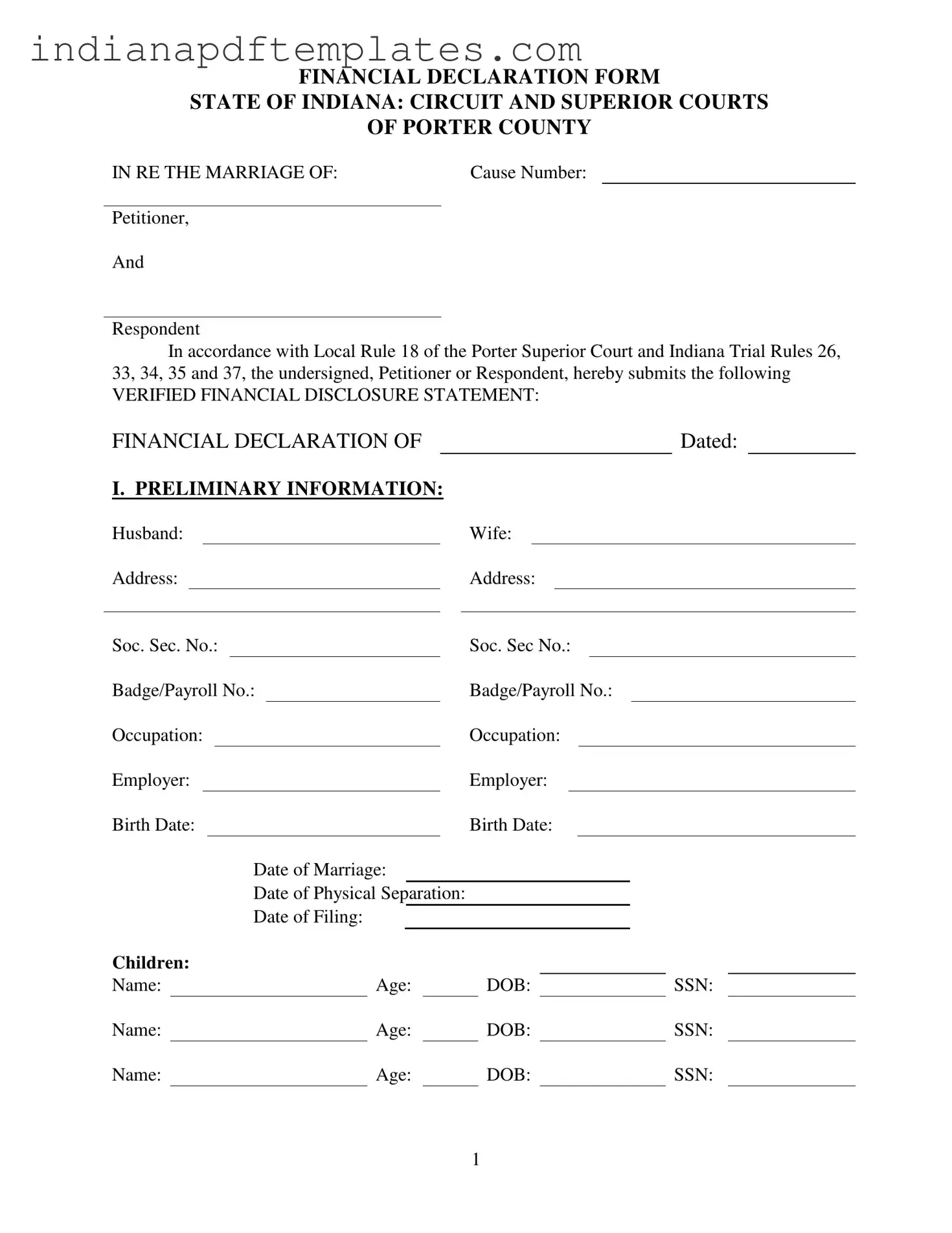
Printable Indiana Financial Declaration Form
Indiana Financial Declaration Sample

FINANCIAL DECLARATION FORM
STATE OF INDIANA: CIRCUIT AND SUPERIOR COURTS
OF PORTER COUNTY
IN RE THE MARRIAGE OF: |
Cause Number: |
Petitioner,
And
Respondent
In accordance with Local Rule 18 of the Porter Superior Court and Indiana Trial Rules 26, 33, 34, 35 and 37, the undersigned, Petitioner or Respondent, hereby submits the following
VERIFIED FINANCIAL DISCLOSURE STATEMENT:
FINANCIAL DECLARATION OF |
|
|
|
|
|
|
|
|
Dated: |
|
|||||||||
I. PRELIMINARY INFORMATION: |
|
|
|
|
|
|
|
|
|
||||||||||
Husband: |
|
|
Wife: |
|
|||||||||||||||
Address: |
|
|
Address: |
|
|||||||||||||||
|
|
|
|
|
|
|
|
|
|
|
|
|
|
||||||
Soc. Sec. No.: |
|
|
Soc. Sec No.: |
|
|||||||||||||||
Badge/Payroll No.: |
|
|
Badge/Payroll No.: |
|
|||||||||||||||
Occupation: |
|
|
Occupation: |
|
|||||||||||||||
Employer: |
|
|
Employer: |
|
|||||||||||||||
Birth Date: |
|
|
Birth Date: |
|
|||||||||||||||
|
|
|
|
|
Date of Marriage: |
|
|
|
|
|
|
|
|
|
|
||||
|
|
|
|
|
Date of Physical Separation: |
|
|
|
|
|
|
|
|
|
|||||
|
|
|
|
|
Date of Filing: |
|
|
|
|
|
|
|
|
|
|
||||
Children: |
|
|
|
|
|
|
Name: |
|
Age: |
|
DOB: |
|
SSN: |
Name: |
|
Age: |
|
DOB: |
|
SSN: |
Name: |
|
Age: |
|
DOB: |
|
SSN: |
1

II. HEALTH INSURANCE INFORMATION:
Name and Address of health care insurance company:
Name all persons covered under plan(s):
Weekly cost of total health insurance premium:
Weekly cost of health insurance premium for children only:
Name of the children’s health care providers:
The names of the schools and grade level for each child are:
List any extraordinary health care concerns of any family member:
List any educational concerns of any family member:
III.INCOME INFORMATION:
A.EMPLOYMENT HISTORY:
Current Employer:
Address:
Telephone No.: |
|
|
|
|
Length of Employment: |
|
|
|
|||
Job Description: |
|
|
|
|
|
|
|
|
|
|
|
Gross Income: |
|
|
|
|
|
|
|
|
|
||
|
|
Per week |
|
|
|
Per month |
|
|
Yearly |
||
Net Income: |
|
|
|
|
|
|
|
|
|
||
|
|
Per week |
|
|
|
Per month |
|
|
Yearly |
||
2

B.EMPLOYMENT HISTORY FOR LAST 5 YEARS:
Employer |
|
Dates of Employment |
|
Compensation (per wk/mo/yr) |
|
|
|
|
|
|
|
|
|
|
|
|
|
|
|
C.INCOME SUMMARY:
1.GROSS WEEKLY INCOME from: Salary and wages, including commissions, bonuses, allowances, and
Note: If paid monthly, determine weekly income by dividing monthly income by 4.3
Pensions & Retirement
Social Security
Disability and unemployment insurance
Public Assistance (welfare, AFDC payments, etc.)
Food Stamps
Child supports received for any child(ren) not both of the parties to this marriage
Dividends and Interest
Rents received
All other sources (specify)
TOTAL GROSS WEEKLY INCOME
2.ITEMIZED WEEKLY DEDUCTIONS: from gross income
State and Federal Income Taxes:
Social Security & Medicare Taxes:
Medical Insurance |
|
|
|
|
Coverage: |
Health |
( |
|
) |
|
Dental |
( |
|
) |
|
Eye Care |
( |
|
) |
|
Psychiatric |
( |
|
) |
3

Union or other dues:
Retirement:
Pension fund: Mandatory ( )Optional ( )
Profit sharing: Mandatory ( )Optional( )
401(K): Mandatory ( ) Optional ( )
SEP: Mandatory ( ) Optional ( )
ESOP: Mandatory ( ) Optional ( )
IRA: Mandatory ( ) Optional ( )
403 B: Mandatory ( ) Optional ( )
Child Support withheld from pay (not including this case)
Garnishments (itemize on separate sheet)
Credit Union debts
Direct Withdrawals Out of Paychecks:
Car Payments
Life Insurance
Disability Insurance
Thrift plans
Credit Union Savings
Bonds
Donations
Other (specify)
Other (specify)
TOTAL WEEKLY DEDUCTIONS:
3. WEEKLY DISPOSABLE INCOME:
(A minus B: Subtract Total Weekly Deduction from Total Weekly Gross Income)
IN ALL CASES INVOLVING CHILD SUPPORT: Prepare and attach an Indiana Child Support Guideline Worksheet (with documentation verifying your income); or, supplement with such a Worksheet within ten (10) days of the exchange of this Form.
IV. MONTHLY LIVING EXPENSES:
House
1.Rent (Mortgage)
2.2nd Mortgage
4

3.Line of Credit
4.Gas/Electric
5.Telephone
6.Water
7.Sewer
8.Sanitation (garbage)
9.Cable
10.Satellite
11.Internet
12.Taxes (real estate – if not included in mortgage payment
13.Insurance (house – if not included in mortgage payment)
14.Lawn Care/Snow Removal
Groceries
1.Food
2.Toiletries
3.Cleaning Products
4.Paper Products
Clothing
1.Clothes
2.Shoes
3.Uniforms
Health Care
1.Health Insurance not deducted from pay
2.Dental Insurance not deducted from pay
3.Doctor visits
4.Dental visits
5.Prescription Pharmaceutical
5

6.
7.Glass/contact lenses
8.Other
Car & Travel
1.Car Payment
2.Gasoline
3.Oil/Maintenance
4.Insurance (car)
5.Car Wash
6.Tolls
7.Train/Bus
8.Parking Lot Fees
9.License Plates
Beauty Care
1.Hair Dress/Barber
2.Cosmetics
School Needs
1.Lunches
2.Books
3.Tuition/Registration
4.Uniforms
5.School Supplies
6.
Infant Care
1.Diapers
2.Baby Food
6

Miscellaneous
1.Church Donations
2.Charitable Donations
3.Life Insurance
4.Babysitter
5.Newspapers & Magazines
6.Cigarettes
7.Dry Cleaning
8.Entertainment
9.Cell Phone
10.Dues/Subscriptions
11.Charge Cards
12.Other (specify)
Average Weekly Expenses (multiply monthly expenses by 12 and divide by 52)
V. PROVISIONAL ARREARAGE COMPUTATIONS:
If you allege the existence of a child support, maintenance, or other arrearage, attach all records or other exhibits regarding the payment history and complete the child support arrearage.
You must attach a Child Support Guideline Worksheet to your Financial Declaration Form or one must be exchanged with the opposing party/counsel within 10 days of receipt of the other parties= Financial Declaration Form.
7

ASSETS
All property is to be listed regardless of whether it is titled in your name only or jointly of if the property you own is being held for you in the name of a third party.
VI. PROPERTY:
A. MARITAL RESIDENCE:
Description:
Location:
Date Acquired: |
|
Titled: |
|
||
Purchase Price: |
|
Down Payment: |
|
||
Source of down payment: |
|
|
|
|
|
Current Indebtedness: |
|
|
|
|
|
Monthly Payment: |
|
|
|
|
|
Current Market Value: |
|
|
|
|
|
B.OTHER REAL PROPERTY: (Complete B on a separate sheet of paper for each additional parcel of real estate owned etc.)
Description:
Location:
Date Acquired: |
|
Titled: |
|
||
Purchase Price: |
|
Down Payment: |
|
||
Source of down payment: |
|
|
|
|
|
Current Indebtedness: |
|
|
|
|
|
Monthly Payment: |
|
|
|
|
|
Current Market Value: |
|
|
|
|
|
8

C.PERSONAL PROPERTY: (motor vehicles, boats, motorcycles, furnishings, household goods, jewelry, firearms, etc. Household furnishings and household goods such as pots and pans need not
be itemized).
Description
Titled
Current Value
Indebtedness
Payment
Present User
VII. BANK ACCOUNTS:
Name
Type of Account
(Checking, Savings,
CD’s, etc.)
Owner
Account No.
Balance on Date of Filing
VIII.
Name
Type of Account
(Money Mkt, Stocks,
Bonds, Mutual Funds)
Owner
Account No.
Value on date of filing
9

IX. LIFE INSURANCE POLICIES (whole life, variable life, annuities, term)
Company
Owner
Policy #.
Beneficiary
Face Value
Loan
Amount
Cash Value
X.RETIREMENT ACCOUNTS (Pension, Profit Sharing, 401(K), SEP, IRA, KEOGH, ESOP, etc.)
Company
Type of Plan
Owner
Account #
Vested (yes/no)
Value as of date of filing
XI. OTHER PROFESSIONAL OR BUSINESS INTERESTS:
Name of Business
Type (Corp., Part., Sole Owner
% Owned
Estimated Value
XII. MARITAL BILLS, DEBTS, AND OBLIGATIONS: (list every single bill, debt and obligation regardless of whether the bill is title in your name, your spouse=s name, or jointly. Please include all mortgages, 2nd mortgages, home equity loans, charge cards, other loans, credit union loans, car payments, and unpaid medical bills, etc. Do not include monthly expenses such as utilities that are paid in full every month).
Creditor
Description
Acct. #
Monthly
Payment
Balance as of
Date of Filing
Current
Balance
10
File Characteristics
| Fact Name | Detail |
|---|---|
| Purpose | The Indiana Financial Declaration form is used to provide a comprehensive overview of an individual's financial situation during legal proceedings, such as divorce or child custody cases. |
| Governing Law | This form is governed by Indiana Code Title 31, which pertains to Family Law and Juvenile Law. |
| Income Reporting | Individuals must report various sources of income, including wages, pensions, and child support received from prior marriages. |
| Expense Disclosure | The form requires detailed disclosure of monthly expenses, including taxes, housing costs, and healthcare expenses. |
| Asset Declaration | Users must list all known assets, such as real estate, vehicles, and financial accounts, along with their estimated values. |
| Legal Obligation | Signatories must declare that the information provided is true and correct, under penalty of perjury, and update the form if their financial situation changes. |
Essential Points on This Form
What is the purpose of the Indiana Financial Declaration form?
The Indiana Financial Declaration form serves as a comprehensive tool for individuals involved in legal proceedings related to divorce or child custody. It helps the court assess each party's financial situation by providing detailed information about income, expenses, assets, and liabilities. This information is crucial for determining child support, alimony, and the division of marital property. By accurately completing this form, parties can ensure that their financial circumstances are clearly understood and fairly evaluated by the court.
Who needs to complete the Financial Declaration form?
Both parties in a divorce or custody case are required to complete the Financial Declaration form. This includes the husband and wife, or the father and mother, depending on the specific circumstances of the case. Each party must provide their financial information to ensure transparency and fairness in the proceedings. Failing to submit this form can lead to delays in the legal process and may negatively impact decisions regarding support and asset division.
What information is required on the form?
The form requires a variety of information, including:
- Gross weekly income from all sources, such as salary, pensions, and child support from prior marriages.
- Monthly expenses, including taxes, housing costs, and healthcare expenses.
- A detailed list of assets, such as real estate, vehicles, and retirement accounts.
- Any debts or liabilities associated with those assets.
It is essential to be thorough and honest when filling out this form. Inaccuracies or omissions can lead to legal complications and may affect the outcome of the case.
What happens if the information on the Financial Declaration changes?
If any information provided on the Financial Declaration changes before the trial, it is the responsibility of the party to update the form. This obligation includes supplementing or amending the declaration to reflect accurate financial circumstances. Failure to do so can result in penalties, including potential negative consequences in court. Keeping the declaration up-to-date ensures that the court has the most accurate information available when making decisions regarding support and asset division.
Misconceptions
- Misconception 1: The Indiana Financial Declaration form is only for high-income individuals.
- Misconception 2: You can skip reporting certain income sources.
- Misconception 3: The form is optional and can be ignored.
- Misconception 4: Only assets owned at the time of filing need to be reported.
- Misconception 5: The form only considers current expenses.
- Misconception 6: You can estimate values instead of providing accurate figures.
- Misconception 7: You don’t need to update the form after filing.
- Misconception 8: The form is only for the spouse who earns income.
- Misconception 9: Submitting the form guarantees favorable outcomes in court.
This form is required for anyone going through a divorce or custody proceedings, regardless of income level. It helps the court understand both parties' financial situations.
All sources of income must be disclosed, even if they seem minor. This includes things like bonuses, alimony from previous marriages, and any side income.
Completing this form is mandatory in Indiana when filing for divorce. Failing to submit it can delay proceedings or negatively affect your case.
All assets, including those acquired before the marriage or through inheritance, must be disclosed. This ensures a fair evaluation of the marital estate.
The Financial Declaration requires a comprehensive view of both current and anticipated expenses, which can include future costs for children’s education or healthcare.
While some estimates may be necessary, you should strive to provide accurate values for assets and debts. This helps the court make informed decisions.
If your financial situation changes before the trial, you are required to update the Financial Declaration. Keeping it accurate is crucial for the court's understanding.
Both spouses must complete the form, regardless of their employment status. This includes stay-at-home parents, who still have financial contributions to the household.
While the Financial Declaration is essential for transparency, it does not guarantee a specific outcome. The court will consider all evidence presented in the case.
Find More Templates
Indiana Entertainment Permit - Organizers should consider the capacity limits stated in the fee structure when planning their events.
To further understand the intricacies of real estate transactions, you may want to explore resources available through Fast PDF Templates, which can provide valuable templates and guidance for creating effective agreements that comply with Texas law.
Pay Sales Tax Indiana - Section II asks for details about customers to whom fuel was sold.